How Bungad works
Every month we put your buyers’ questions to the engines we hold an API key for, record which brands were named and which pages were cited, write the fixes that would have earned you the mention, and publish the result in the app. Today that means Perplexity, and only Perplexity.
This page is the mechanism rather than the pitch. If you want the arithmetic that turns a set of answers into a number, that is how we measure AI visibility, written out with worked examples. If you want the concept before the machinery, start at what answer engine optimization is. What follows is what actually happens, in the order it happens, including the parts that are a person typing rather than software running.
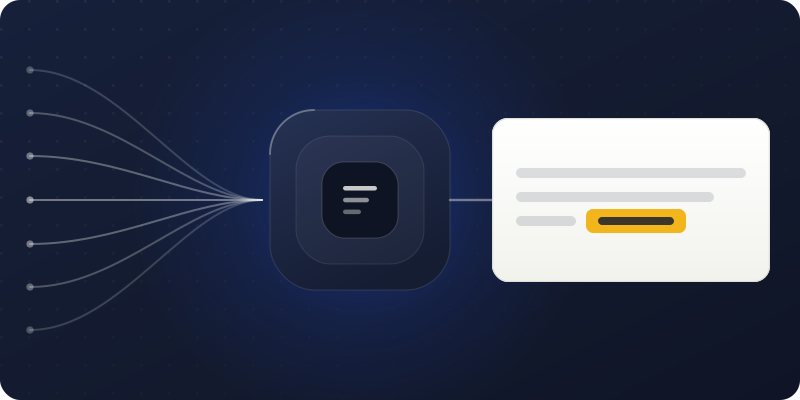
Setting up, in the order it happens
Five steps, and none of them can be skipped ahead of the one before it: nothing can be fixed before it has been measured, and nothing can be measured before there is an agreed question to measure it against.
Name the brand and the domain
Both, because they do different jobs. The brand name is what we look for in the text of an answer, matched as a whole word and ignored inside links — a link to your site is a citation, which is counted separately, not a mention. The domain is what we look for in the list of sources the engine credited.
This is also the first place we will tell you something unwelcome. A brand whose name is an ordinary English word is genuinely harder to measure, because a whole-word match on it will sometimes catch a sentence that was not about you. We would rather say that at the start than hand you a flattering number later.
Agree the question set
Questions in the words your buyers actually use, not in your product’s vocabulary. The ceiling is the plan’s: twenty-five tracked questions on Starter, one hundred on Growth, five hundred on Scale, counted per brand rather than across the account.
One rule here is not negotiable, and it is the rule most tools get wrong. A question that contains your own brand name is asked, stored and shown to you — what an engine says in reply to “is yourbrand any good?” is real intelligence — but it is excluded from the score, with the reason attached. Its mention was handed over by the question rather than earned, so it cannot be lost, so it cannot move, so all it can do is inflate the number by however many such questions you happen to track. More on picking a set that can actually go down: which questions should you track.
Run the baseline check
The first run is not a report card, it is the zero point. Everything afterwards is read as a change against it, which is why it matters more that it is honest than that it is encouraging.
A baseline of nothing at all is a normal result and not a broken measurement. Ours was: on the eight questions we track on our own behalf, Perplexity named Bungad in 0 of 8 answers, mention rate 0%, citation share 0.0%, visibility score 0 out of 100. We published it rather than waiting for a better one — the whole run is here.
Fix what kept you out of the answer
An engine leaves a brand out for ordinary, findable reasons, and the citation list from the run tells you which one applies: no page of yours answers the question that was asked; a page answers it but buries the answer below the part a reader would quote; the specifics live in an image, a PDF or behind a form; the structured data claims something the visible page does not say; or the sources the engine already trusts in your category do not mention you accurately.
We name the cause, then write the thing that addresses it — the passage, the heading, the markup, the directory entry. The diagnostic order, cheapest check first, is set out in why your brand is not in AI answers.
Repeat on the same questions, every month
Same questions, same engine, same arithmetic, published either way. That repetition is the entire reason this is a subscription rather than a project: models are updated, competitors publish, and a number measured once describes a day rather than a position.
What a run is, mechanically
A run is one API call per tracked question per configured engine. Each answer that comes back is read for four signals, and each is stored with the answer it came from:
| Signal | How it is taken | What it feeds |
|---|---|---|
| Named or not | Whole-word match on the brand name, with links blanked out first | Mention rate |
| Position | Where your first mention falls among all the brands the answer names | The position component |
| Sentiment | Cue phrases around the mention, read as positive, neutral or negative | Shown, not scored |
| Citations | Every source domain the answer credited, and which of them are yours | Citation share, and the fix list |
Two properties of that process are worth knowing before you read your first report. A call that fails is stored as a failure and excluded, never as an answer that declined to name you — the two are indistinguishable in a table and opposite in meaning. And the engine is not deterministic: when we asked our own eight questions twice about a minute apart, every headline figure reproduced exactly while individual per-domain citation counts moved. Read the citation list as a map of who the engine trusts, not as a scoreboard to a single count.
What you receive, and where
In the app, after every check: the score with its three inputs shown separately, each question with the answer it produced, which brands were named instead of you, every domain the engine cited, and the recommendations that follow from all of it.
Nothing is emailed. There is no email provider configured on this product and no message has ever been sent to a customer. The monthly report is written and tested but dormant, so the report you read is the one in the app. We would rather say that than list an email you would wait for.
What the software does, and what a person does
Worth separating, because a feature list that mixes them reads as though all of it happens while you watch. It does not. The left column is code that runs on a schedule; the right column is work someone does, on request, and it is what differs between plans.
| Software, on every plan | By hand, and on which plan |
|---|---|
| Asks the tracked questions on the keyed engine | Starter, $99 — structured data set up for you |
| Parses each answer for mentions, position, sentiment and citations | Growth, $299 — monthly content fixes written for you, and a monthly call |
| Scores the run and stores it whole | Scale, $799 — source building, and a named strategist you work with directly |
| Shows the score, sources and recommendations in the app | Google AI Overviews and Microsoft Copilot, reviewed by hand for Scale clients, because neither has a public API |
The manual-check allowance is on the same axis: a scheduled check each month on every paid plan, plus four manual checks on Starter, twenty on Growth and one hundred on Scale. The full breakdown, and where our prices sit against the rest of the market, is on what AEO costs per month.
What you have to do
- Publish the fixes. We write them; you or your developer ship them. Nothing changes in an engine’s answer because a recommendation exists in a dashboard.
- Tell us when the product changes. A new price, a new market, a dropped feature. The questions worth tracking follow the business, and we cannot see that from outside.
- Leave the question set alone between changes. Tune it when the market moves, not when a number disappoints.
- Read the citation list, not just the score. The score says where you stand. The cited domains say where the work is.
What does not happen
Stated plainly, because every item here is something a buyer would otherwise assume.
- No automated coverage beyond the keyed engine. Perplexity today. ChatGPT and Claude are built and unkeyed; Gemini is not built; AI Overviews and Copilot have no API and are reviewed by hand for Scale clients.
- No guarantee of a mention. Nobody controls what a model generates, and a provider who promises placement is describing a product that does not exist.
- No edits to a model’s training data. That is not a thing a vendor can sell. What is possible is changing what the engine finds when it looks — see correcting something an AI gets wrong.
- No market, country or language segmentation. Measurement is English-phrased today, and there is no notion of a market anywhere in the run.
- No email. As above: dormant, not delivered.
Why monthly
Because the run-to-run variation we measured on ourselves is large enough that a daily series would mostly plot noise, and small enough that a month is long enough for a published fix to show up. The evidence for that interval, and when checking off-schedule is actually worth it, is in how often to check your AI visibility.
Common questions
How does Bungad actually work?
Each month we send your tracked questions to the engines we hold an API key for, one call per question per engine, and parse every answer for four things: whether your brand is named as a whole word outside any link, the order the named brands appear in, the tone of the sentence naming you, and every source domain the answer cited. Those signals become a score, a list of who was named instead, and a list of the domains the engine drew on. The diagnosis and the fixes are written against that list, and the whole thing repeats on the same questions the following month.
Which engines does a Bungad run query today?
Perplexity, and only Perplexity. It is the one engine we hold an API key for, so it is the only one a run can query. The ChatGPT and Claude adapters are written but hold no key, and no run has ever queried either of them. Gemini is not built. Google AI Overviews and Microsoft Copilot expose no public API at all, so they are reviewed by hand for Scale clients rather than automated. Every plan gets whatever we have keyed at the time, which today means one engine on all three.
Do you need access to my website?
No. The measurement reads nothing of yours: it reads what the engine says about you. For the fixes we write the passage and the markup and hand it over, and you publish it. If you would rather we published it, that needs whatever access your own stack requires, and it is arranged directly rather than through the app. Nothing in the product has ever held a credential for a customer’s website.
What happens if an engine call fails mid-run?
It is recorded as a failed call and left out of the arithmetic. It is never counted as an answer that failed to name you, because those two things look identical in a table and mean opposite things — one is a measurement, the other is a missing measurement. The run reports how many calls it completed so a thin month cannot pass as a bad month.
Why is the question set fixed rather than rewritten every month?
Because a score is only comparable against itself. Change the questions and the new number measures a different thing, so a rise cannot be told apart from an easier question set. You can change tracked questions whenever you like, and the change is worth making when your market moves — but the month it changes is a new baseline, not an improvement, and we label it that way.
More of them, including the ones that go against us, are on the frequently asked questions.
Start with the baseline
Enter your domain and we run a short version of step three on you: the questions, who was named, and which domains the engine cited.
3 questions on Perplexity, free. A domain checked in the last week is served from that stored run rather than asked again, and the daily free allowance resets at midnight UTC.