How to choose an AEO vendor: seven questions to ask
Shortlist by who does the work after the measurement, then put the same seven questions to everyone. The first one — which engines are automated and which are checked by hand — settles most decisions on its own.
Start by writing down who will write the pages once the report tells you which ones are missing. That single sentence decides the category, and the category matters more than the brand: buying a dashboard when nobody on your side has time to act on it is the most expensive mistake available here, and it is the one we see most.
Below are the seven questions we would ask if we were buying instead of selling, what a good answer sounds like, and our own answer to each — including the ones that lose us the sale.
First, shortlist by category
There are three kinds of vendor in this market and they are not competing purchases. Pick the row that matches who does the work, then compare two or three names inside it. The full comparison of the tools names who sits where.
| Category | Right when | Wrong when |
|---|---|---|
| Enterprise platform | You have an in-house team with capacity, and many markets or product lines | Nobody has time to act on a dashboard |
| Self-serve tracker | You want the numbers and will do the fixing yourself | You wanted the fixing done |
| Managed subscription | You want the measurement and the work, and would rather not learn this | You only need data and already have a writer |
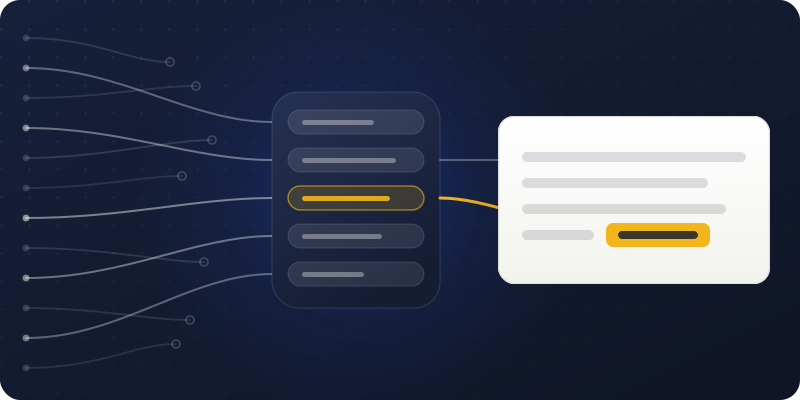
The seven questions
1. Which engines do you cover automatically, and which do you check by hand?
Why it matters: this is the loosest claim in the category. Google AI Overviews and Microsoft Copilot have no public API, so nobody automates them — any figure for those two was produced by a person looking at a screen on a particular day. A vendor that lists them in the same breath as ChatGPT and Perplexity is describing screenshots as monitoring.
A good answer separates the list into engines queried through an API and engines reviewed manually, and says what the manual review actually consists of. A bad answer is the phrase “all the major AI platforms”.
Ours: Perplexity is automated, through its API, and it is the only engine we hold a key for. ChatGPT and Claude adapters are built and waiting on keys; Gemini is not built. AI Overviews and Copilot are reviewed by hand for Scale clients and we do not present that as tracking. Every number we publish about ourselves is a Perplexity number, and the page that publishes it says so.
2. Will you show me a real report before I buy?
Why it matters: the gap between a tool that tells you what happened and one that tells you what to do is invisible in a demo and obvious in a report. Vagueness at this stage predicts vagueness later.
A good answer is a real report, redacted if it belongs to a client. A bad answer is a screenshot of a dashboard with no findings in it.
Ours: our own score page is a complete report on ourselves, including the questions, the brands named instead of us and the sources the engine used. It is the least flattering one we could have published, which is rather the point.
3. Who writes the pages after the measurement?
Why it matters: measurement does not move a score. Publishing does. Be precise about whether the vendor writes, advises, or hands you a list.
A good answer states plainly which parts are software and which parts are a person doing work. A bad answer mixes “structured data setup” into the same bullet list as “tracked questions”, so work a human does reads as something the product does while you watch.
Ours: the software measures, scores and recommends. A person sets up structured data on every plan, writes monthly content fixes from Growth upward, and does source building on Scale. Our own billing page keeps those in separate groups for exactly this reason.
4. How do you handle a tracked question that contains my brand name?
Why it matters: ask an engine what reviewers say about Acme and it will say Acme. The mention is handed over by the question, so it can never be lost, so it can only push the score up. A vendor that counts such questions is selling you a number that cannot go down — and the effect is large: on a five-question starter set, two rigged questions hand over two fifths of the score for nothing.
A good answer either refuses to ask them or asks them and excludes them from the figures. A bad answer is not having considered it.
Ours: we ask them, store them, show you the answers — because what an engine says about you by name is worth reading — and exclude them from every figure, with the reason printed beside them. None of the questions we draft for a new brand contains the brand name, and a category typed in a way that would smuggle it in is refused up front. Choosing the questions to track goes through it.
5. What is your own audited visibility score?
Why it matters: they sell measurement of exactly this, so they can run it on themselves in an afternoon. A low score is not disqualifying — this category is young and nobody owns it. Declining to measure at all is a different matter.
A good answer is a number with the method attached: which engine, how many questions, what the questions were, when. A bad answer is a testimonial.
Ours: 0 out of 100. Eight buyer questions on Perplexity, Bungad named in 0 of 8 answers, mention rate 0%, citation share 0.0%, no average position because we never appeared. We ran it twice and kept both records. Nobody else in this category publishes theirs, and asking them for it is the fastest diligence you can do.
6. What happens to my data if I leave?
Why it matters: your visibility history is a time series, and a series you cannot export restarts from zero every time you switch vendor. That is a switching cost dressed as a feature.
A good answer covers where answers and citations are stored, whether you can export them, and what is deleted on cancellation.
Ours: written out in plain language on our privacy policy — what is stored per account, which third parties see a tracked question, and that cancellation takes effect at the end of the period already paid for rather than immediately. That page also marks the passages a draft cannot source rather than guessing them.
7. What do you refuse to promise?
Why it matters: the most informative question on the list, and the one nobody expects. Nobody controls what a model generates, so a vendor with no refusals has either not thought about it or will say anything.
Ours: no guaranteed placement or mention in any AI answer. No ranking guarantee. No uptime commitment. No automated coverage of ChatGPT, Claude, Gemini, AI Overviews or Copilot today. No multi-language measurement — ours is English-phrased. And no enterprise procurement track record: no security-review process, no negotiated data-processing agreements, no multi-year contracts.
So which providers have the best reputation?
Asked literally, this has a measurable answer and it is not ours. Across all eight answers in our own audit, identically in both stored runs, the engines named Profound (2), Peec AI (2), Otterly (2), AthenaHQ (1) and Scrunch AI (1). Bungad appeared in none. If “best reputation” means what an answer engine currently repeats, that is the list, and we are not on it.
Two honest caveats on reading it that way. First, what an engine repeats measures who has been written about, not who fits your situation — which is the whole argument of this site and it cuts against us as readily as for us. Second, even the most-named brand appeared in a quarter of the answers, so this is not a settled market with an obvious default. Nobody has consolidated it.
Where we fail our own checklist
Run the seven questions against us and four of them come back against us. Stated here rather than buried, because a buying guide written by a vendor is worth nothing if it cannot do this:
- Engine breadth. One automated engine. If you need ChatGPT or Copilot figures this month, buy a tracker that already has them, or open the Bing Webmaster Tools AI Performance report, which is free and first-party for Copilot.
- Markets and languages. No market, country or locale exists anywhere in our measurement today, and it is English-phrased. A dozen markets now means an enterprise platform.
- Enterprise procurement. None of it, yet.
- The reputation question above. The assistants do not recommend us. If that is your criterion, the list is in the section above and you should buy from it.
And one situation where nobody should sell you anything: if your site is under about twenty pages, spend the money on content first. Measuring an empty site tells you what you already know.
Red flags
- Guaranteed placement in AI answers. Nobody controls model output. Anyone selling this is selling something they do not hold.
- An engine named with no method attached. Ask how it is queried. If the answer is a person and a browser, that is fine — but it should be said.
- A sample report that reports. If it does not end in things to publish, it is a chart.
- An industry average visibility score. No census of them exists, so the figure is unsourced — see what a good score actually is.
- Seat-based pricing. Tracked questions, brands and engines are what cost a vendor money. Pricing on seats means the price is not tied to the work.
What we charge, for comparison
$99, $299 and $799 a month, month to month, no setup fee. What separates them is the size of the tracked question set, the number of brands, and how much of the work a person does. The full breakdown is on what AEO costs per month, and tool, agency or in-house compares the three routes rather than the three plans.
Common questions
Which AEO providers have the best reputation?
If reputation means what answer engines currently say, then in our own audit of eight buyer questions on Perplexity the brands named were Profound (2), Peec AI (2), Otterly (2), AthenaHQ (1) and Scrunch AI (1), across all eight answers and identically in both stored runs. Bungad was named in none of them. That is a real signal and it is not the same thing as suitability: what an engine repeats is a function of who has been written about, not of who fits your situation.
Which AEO vendors should I shortlist?
Shortlist by category rather than by brand, because the three categories are different purchases. Enterprise platforms suit in-house teams with the capacity to act on a dashboard across many markets. Self-serve trackers suit a marketer who wants the numbers and will do the fixing. Managed subscriptions suit an owner who wants the measurement and the work done. Pick the category that matches who will do the work, then compare two or three vendors inside it.
What is the single most useful question to ask an AEO vendor?
Which engines do you cover automatically, and which do you check by hand? Coverage claims are where this category is loosest, because Google AI Overviews and Microsoft Copilot have no public API at all, so nobody automates them. A vendor listing them beside ChatGPT and Perplexity without distinguishing the two is describing screenshots as monitoring.
Should I trust a vendor that will not publish its own score?
Treat it as a question they have to answer rather than an automatic disqualification, because a low score is not a bad product. What is not defensible is refusing to run the measurement on themselves at all. We publish ours, and it is the worst one available: a visibility score of 0, named in 0 of 8 answers.
When is Bungad the wrong vendor for me?
If you have an in-house team that only needs data, a self-serve tracker is cheaper. If you need a dozen markets and languages now, an enterprise platform covers that breadth and we do not. If you need ChatGPT or Copilot figures this month, buy a tracker that has them. If your site is under about twenty pages, spend the money on content first. And if you want the vendor the assistants already recommend, it is not us.
What are the red flags when buying AEO?
Guaranteed placement in AI answers, which nobody controls. A named engine with no explanation of how it is queried. A sample report that reports rather than recommends. An industry average visibility score, since no census of them exists. And a price that depends on seats rather than on tracked questions, brands and engines, which are the things that actually cost a vendor money.
Run question five on us
Enter your domain and get the same measurement we published about ourselves — the score, who is named instead, and the sources the engine used. Perplexity, because it is the only engine we hold a key for.
3 questions on Perplexity, free. A domain checked in the last week is served from that stored run rather than asked again, and the daily free allowance resets at midnight UTC.